Runtime View
Nine scenarios cover the system at runtime. Three are error or recovery scenarios: Context Auto-Compaction, User Interruption and LLM Rate-Limit. Together the scenarios exercise every building block from [section-building-block-view].
Startup and Session Resume
On launch the front end resolves the working directory and trust, builds configuration, then either starts fresh or restores a past session.
-
The Config Subsystem walks project
.vibe/directories (BFS, up to four levels) then the user~/.vibe/layer and merges them [vibe/core/paths/_local_config_walk.py:132-168, vibe/core/config/builder.py:24-122]. -
--continueresolves the latest session for the current TTY/working directory;--resume [ID]loads a specific session or opens a picker. Both requiresession_logging.enabled[vibe/cli/cli.py:128-190, vibe/core/session/session_loader.py:64-116]. -
Restored non-system messages are replayed into the Agent Loop and the session id / parent id are reattached [vibe/cli/cli.py:180-190].
Conversation Turn (happy path)
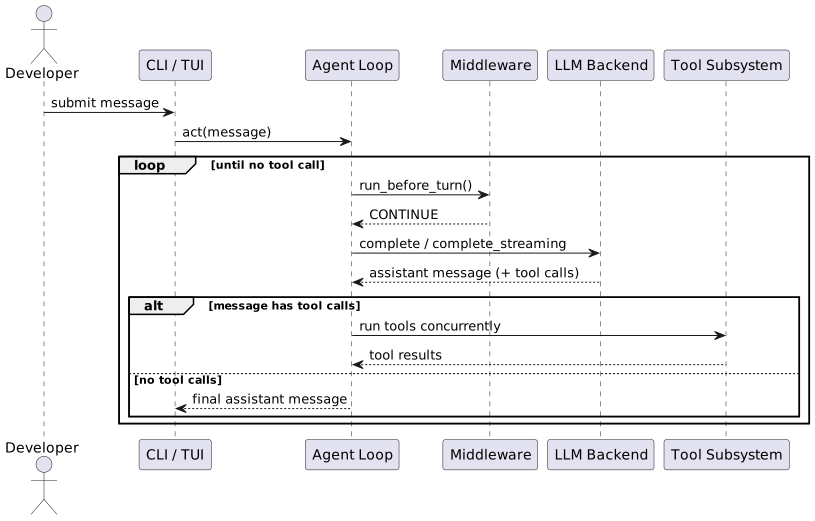
_conversation_loop appends the user message, runs the middleware
pipeline, performs the LLM turn, and executes any tool calls as
concurrent asyncio tasks before looping again
[vibe/core/agent_loop.py:855-937, vibe/core/agent_loop.py:1217-1259].
Tool Approval Interception
Before a tool runs, _execute_tool_call resolves its permission. An
ASK tier invokes the approval callback into the UI; a rejection
increments tool_calls_rejected and feeds a rejection result back to the
LLM so the conversation continues
[vibe/core/agent_loop.py:1071-1167, vibe/core/tools/permissions.py:47-68].
Approved patterns are remembered in the PermissionStore for the rest of
the session.
Context Auto-Compaction (recovery scenario)
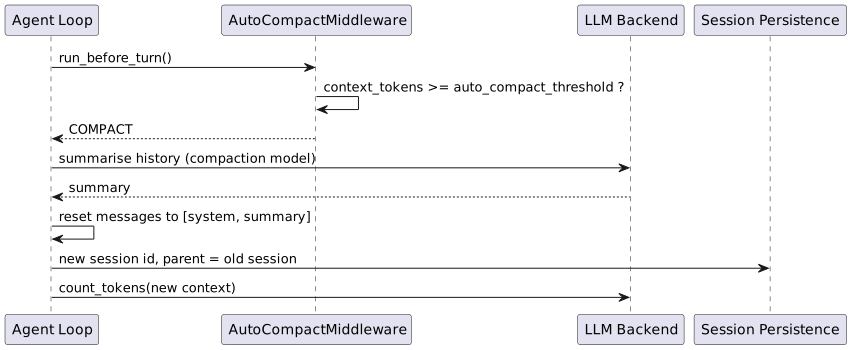
When context_tokens crosses the model’s auto_compact_threshold,
AutoCompactMiddleware returns COMPACT; the loop summarises the
history into [system, summary], forks to a new session id linked to its
parent, and recounts tokens
[vibe/core/middleware.py:81-96, vibe/core/agent_loop.py:1681-1749].
User Interruption (error / recovery scenario)
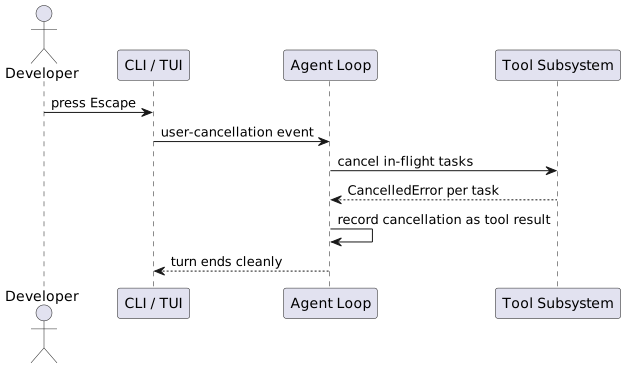
Escape raises a user-cancellation event; in-flight tool tasks receive
asyncio.CancelledError, the cancellation is recorded as a tool result,
and the loop breaks without corrupting the message history
[vibe/core/agent_loop.py:897-906, vibe/core/agent_loop.py:1170-1178, vibe/core/agent_loop.py:1244-1259].
LLM Rate-Limit / Context-Too-Long (error scenario)
_chat catches rate-limit and context-too-long errors raised by the LLM
Backend Layer and surfaces them distinctly; the Mistral backend retries
transient failures with exponential backoff before the error propagates;
the ACP Bridge maps a context-too-long failure to a JSON-RPC
ContextTooLongError
[vibe/core/agent_loop.py:1365-1374, vibe/core/llm/backend/mistral.py:212-222, vibe/acp/exceptions.py:107].
Teleport to Cloud
/teleport (gated by plan eligibility) validates the git repository,
confirms the working commit is pushed, then starts a remote Vibe Code
workflow; RemoteEventsSource attaches and streams the cloud workflow’s
events back into the UI
[vibe/core/teleport/teleport.py:46-150, vibe/core/teleport/git.py:27-100, vibe/core/nuage/remote_events_source.py:33-120].
ACP Session
vibe-acp runs VibeAcpAgentLoop, the ACP agent (see
[section-building-block-view]), as an ACP agent over stdio. The agent
holds one AcpSessionLoop per ACP session: new_session creates a fresh
AcpSessionLoop with the default agent; load_session replays a past
conversation. ACP-specific tools delegate file and terminal operations to
the connected ACP client
[vibe/acp/session.py:11, vibe/acp/acp_agent_loop.py:614-648, vibe/acp/acp_agent_loop.py:869-920, vibe/acp/tools/base.py:13-54].
First-Run Onboarding
When no API key is configured, the Setup block walks the user through
Welcome → auth-method → browser sign-in or manual API key, then persists
the key to ~/.vibe/.env (or keyring)
[vibe/setup/onboarding/screens/welcome.py:46-80, vibe/setup/auth/api_key_persistence.py:38-64].
Feedback
Was this page helpful?
Glad to hear it! Please tell us how we can improve.
Sorry to hear that. Please tell us how we can improve.