Vibe — Architecture Documentation
1. Introduction and Goals
Vibe is Mistral’s minimal CLI coding agent: a terminal coding assistant
that gives a conversational interface to a codebase, powered by Mistral’s
models [pyproject.toml:5, README.md:20-22]. It ships two entry points —
vibe/ (an interactive Textual TUI, also runnable non-interactively) and
vibe-acp (an Agent Client Protocol server for editors and IDEs)
[pyproject.toml:143-144].
1.1. Requirements Overview
The system lets a developer explore, modify and run a project through natural language, backed by a safe tool suite [README.md:92-109]. Its core capabilities:
-
Run an interactive coding session driven by an agent loop that calls the LLM, then executes tool calls, until the assistant produces no further tool call [vibe/core/agent_loop.py:855-937].
-
Run non-interactively (vibe/ -p) for scripting and CI, with turn and cost limits and machine-readable output [vibe/core/programmatic.py:27-91, vibe/core/output_formatters.py:46-119].
-
Provide a built-in tool suite: shell, file read/write/patch, code search, todo, subagent delegation, interactive questions, web fetch and search [vibe/core/tools/builtins/].
-
Extend the agent through MCP servers, skills, custom agent profiles and hooks [README.md:340-579].
-
Persist, resume and rewind sessions [vibe/core/session/session_logger.py:36-97].
The full functional specification — persona use cases and per-interface
system use cases — is in ../../use-cases-vibe.adoc; the product framing
is in ../../prd-vibe.adoc.
1.2. Quality Goals
The quality goals below are inferred from the emphasis the code and README place on them. The code cannot rank the eight ISO/IEC 25010 characteristics, so both the selection of these as the top goals and their priority ranking could not be recovered from code and are deferred — the Product Owner and Architect must confirm them before they can drive trade-off decisions.
| Quality Goal | Motivation | Chapter 4 Approach |
|---|---|---|
Security / Safety |
"Safety first" is an explicit README theme; tool execution is gated by a tiered permission system and a trust-folder gate [README.md:108, vibe/core/tools/base.py:83-113, vibe/core/trusted_folders.py:75-122]. |
Tiered tool permissions, trust gate, workdir boundary (see Solution Strategy). |
Usability |
A rich Textual TUI, a first-run onboarding wizard and autocompletion target a low-friction developer experience [vibe/cli/textual_ui/app.py:327-348, vibe/setup/onboarding/screens/welcome.py:46-80]. |
Textual TUI, onboarding wizard, slash-command and path autocompletion. |
Maintainability |
Strict pyright and ruff gate CI; hexagonal ports decouple the engine from adapters [AGENTS.md:24-69, vibe/core/llm/backend/base.py:13-126]. |
Hexagonal ports/adapters, strict static analysis, test doubles. |
Compatibility |
The agent works against multiple LLM providers and integrates the MCP and ACP protocols and the agentskills.io standard [vibe/core/llm/backend/factory.py:7, vibe/acp/entrypoint.py:78]. |
LLM backend factory, MCP registry, ACP bridge. |
Reliability |
The LLM call retries with backoff and the loop recovers from context overflow and user interruption [vibe/core/llm/backend/mistral.py:212-222, vibe/core/agent_loop.py:1681-1749]. |
Retry/backoff, middleware limits, auto-compaction recovery. |
|
Note
|
Chapter 10 covers all eight ISO/IEC 25010 characteristics in its quality tree and gives measurable six-part scenarios for the characteristics that concretise these top goals; this section names only the top goals that drive architecture decisions. |
1.3. Stakeholders
| Role | Contact | Expectations |
|---|---|---|
Interactive developer |
(team to supply) |
A trustworthy conversational agent that explores and edits the codebase with explicit approval [vibe/cli/textual_ui/app.py:322]. |
Scripter / CI automation |
(team to supply) |
Deterministic non-interactive runs with turn and cost ceilings and machine-readable output [vibe/core/programmatic.py:27]. |
Editor / IDE integrator |
(team to supply) |
A stable ACP server to embed the agent in an editor [vibe/acp/entrypoint.py:78-108]. |
Product Owner |
(team to supply) |
Owns the deferred business questions: why Vibe was built, success KPIs, and segment priority. |
|
Note
|
Open issues — deferred to the team
The following could not be recovered from code and are deferred:
|
2. Architecture Constraints
2.1. Technical Constraints
| Constraint | Evidence / Rationale |
|---|---|
Python >= 3.12 |
|
|
All commands go through |
Strict static typing |
Pyright runs in strict mode and gates CI; no inline |
Ruff lint and format gate every change |
|
No relative imports |
|
|
The agent loop and tool execution are async; streaming surfaces return
|
UNIX is the supported target |
Vibe runs on Windows but UNIX environments are the officially supported and targeted platform [README.md:24-26]. |
2.2. Organisational and Convention Constraints
| Constraint | Evidence / Rationale |
|---|---|
Hexagonal module conventions |
Abstract interfaces use the |
Pydantic for all external data |
External data is parsed via |
Conventional Commits, no force-push |
|
Apache-2.0 licence |
The project is licensed Apache-2.0 [pyproject.toml:7, LICENSE]. |
2.3. Conventions
Documentation follows Docs-as-Code with AsciiDoc built by docToolchain; this architecture document is the arc42 template filled in place. Code conventions are recorded in AGENTS.md at the repository root and are binding for both human and AI contributors [AGENTS.md:1-12].
3. Context and Scope
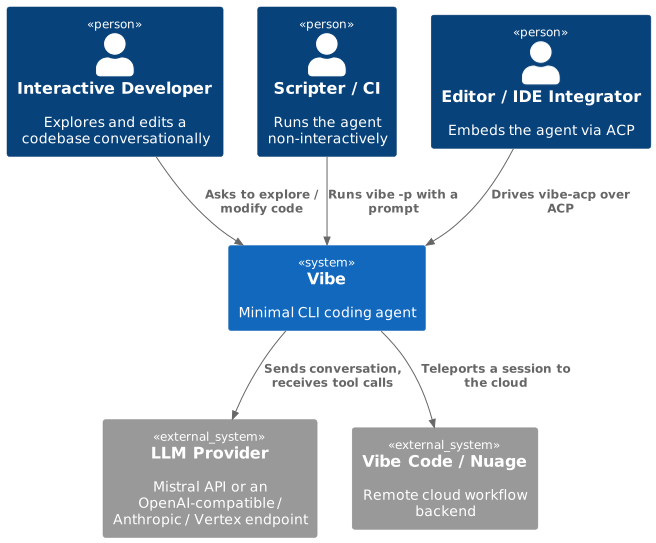
Vibe is a client-side tool that runs on the developer’s machine. The system boundary in this chapter is the same one used in Building Block View: the building blocks there are internal to this boundary, the systems below sit outside it.
3.1. Business Context
The developer states a coding goal; Vibe turns it into LLM calls and tool executions and reports the result. A scripter drives the same engine non-interactively. An integrator embeds the agent in an editor through the ACP server. The LLM Provider supplies the agent’s reasoning; Vibe Code / Nuage optionally continues a session in the cloud [vibe/core/programmatic.py:27, vibe/acp/entrypoint.py:78-108, vibe/core/teleport/teleport.py:46-150].
3.2. Technical Context

| External System | Channel | Code Evidence |
|---|---|---|
LLM Provider API |
HTTPS (Mistral SDK or generic HTTP) |
vibe/core/llm/backend/factory.py:1-7, vibe/core/llm/backend/mistral.py:268-335 |
Mistral Datalake |
HTTPS POST to |
|
GrowthBook |
HTTPS POST to the eval endpoint; fails open on error |
|
MCP Servers |
|
|
Vibe Code / Nuage |
HTTPS + Server-Sent Events |
vibe/core/nuage/client.py:22-100, vibe/core/nuage/remote_events_source.py:33-120 |
GitHub |
OAuth device flow; release lookups |
vibe/core/auth/github.py:117-184, vibe/cli/update_notifier/adapters/github_update_gateway.py |
PyPI |
HTTPS version lookup, cached 24 h |
vibe/cli/update_notifier/adapters/pypi_update_gateway.py, vibe/cli/update_notifier/update.py:82 |
4. Solution Strategy
The table maps each Chapter 1 quality goal to the concrete approach the code uses to reach it. The approaches themselves are visible in code; the reason each was chosen over alternatives is deferred — recorded as Architecture Decisions in Architecture Decisions with status "Accepted (inferred)".
| Quality Goal | Approach in the code |
|---|---|
Security / Safety |
Every tool call resolves to a permission tier — |
Usability |
A Textual TUI renders the conversation with key bindings, slash
commands and |
Maintainability |
The engine is structured as hexagonal ports ( |
Compatibility |
An LLM backend factory selects a provider-specific backend, and
API-style adapters cover OpenAI, Anthropic and Vertex shapes; an MCP
registry and the |
Reliability |
The Mistral backend retries with exponential backoff; a middleware pipeline enforces turn and price limits and triggers auto-compaction when the context nears the model threshold; user interruption cancels in-flight tool tasks cleanly [vibe/core/llm/backend/mistral.py:212-222, vibe/core/middleware.py:49-96, vibe/core/agent_loop.py:1244-1259]. |
4.1. Key architectural patterns
-
Agent loop with a middleware pipeline.
before_turnmiddlewares run ahead of every LLM turn and can stop, inject or compact [vibe/core/middleware.py:218-247] — see ADR-003. -
Ports and adapters (hexagonal).
*_port.pyinterfaces isolate the domain from I/O [AGENTS.md:13-23] — see ADR-001. -
Backend factory.
BACKEND_FACTORYmaps a provider enum to a backend class [vibe/core/llm/backend/factory.py:7] — see ADR-002. -
Layered, merge-aware configuration. Config layers (project then user) merge field-by-field with declared merge strategies [vibe/core/config/builder.py:24-122].
-
File-based session persistence. Sessions are folders of
meta.jsonplusmessages.jsonl[vibe/core/session/session_logger.py:62-97] — see ADR-004.
5. Building Block View
5.1. Whitebox Overall System
- Motivation
-
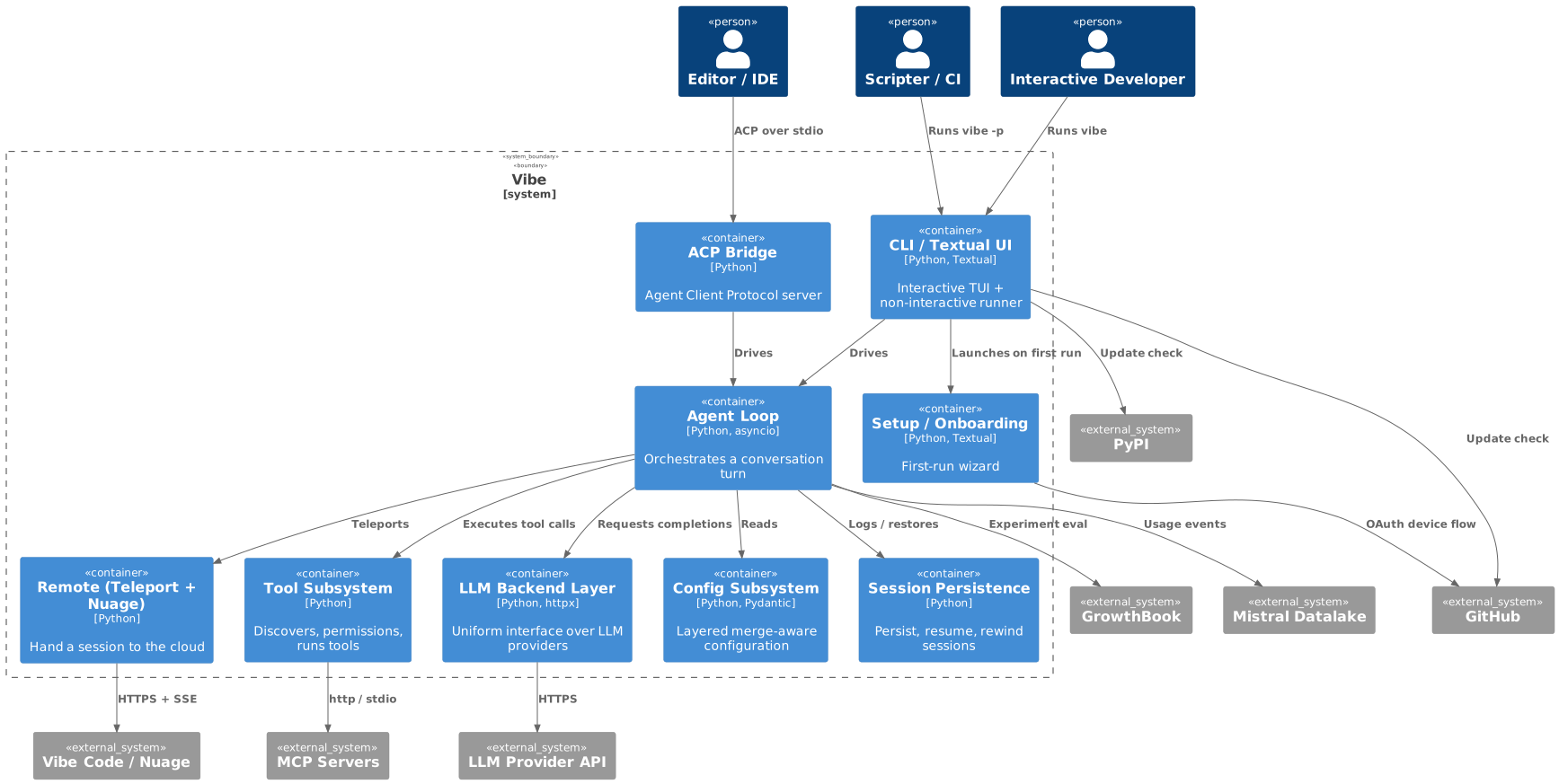
The system separates the two front ends (CLI, ACP) and the first-run wizard (Setup) from a shared
coreengine. Inside the engine the Agent Loop is the orchestrator; the Tool Subsystem, LLM Backend Layer, Config Subsystem and Session Persistence are the capabilities it composes. The Remote block is an optional path that hands a session off to the cloud. - Contained Building Blocks
-
The nine blocks below. The external systems are the same set named in Context and Scope.
- Important Interfaces
-
AgentLoop.act()is the engine’s entry point;BackendLikeis the LLM port;BaseTool.run()is the tool contract;ConfigOrchestratorbuilds configuration.
5.1.1. Agent Loop
Responsibility: Orchestrate one conversation turn — run middleware,
call the LLM, parse and execute tool calls concurrently, update stats,
repeat until the assistant emits no tool call.
Interface: AgentLoop.act() [vibe/core/agent_loop.py:632-649].
Source: vibe/core/agent_loop.py, vibe/core/loop.py,
vibe/core/middleware.py.
Runtime scenarios: all of Runtime View.
5.1.2. LLM Backend Layer
Responsibility: Present a uniform BackendLike protocol —
complete, complete_streaming, count_tokens — over Mistral and
OpenAI-compatible providers, with API-style adapters for OpenAI,
Anthropic and Vertex.
Interface: BackendLike [vibe/core/llm/backend/base.py:13-126],
selected by BACKEND_FACTORY [vibe/core/llm/backend/factory.py:7].
Source: vibe/core/llm/.
Runtime scenarios: Conversation Turn, LLM Rate-Limit.
5.1.3. Tool Subsystem
Responsibility: Discover, filter, instantiate and permission-check
tools — builtin, MCP and connector — and expose them to the loop.
Interface: ToolManager.available_tools / .get()
[vibe/core/tools/manager.py:72-447]; BaseTool.run()
[vibe/core/tools/base.py:122-152].
Source: vibe/core/tools/.
Runtime scenarios: Conversation Turn, Tool Approval.
5.1.4. Config Subsystem
Responsibility: Discover config layers (project .vibe/ then
~/.vibe/), merge them field-by-field into a validated VibeConfig.
Interface: ConfigOrchestrator
[vibe/core/config/orchestrator.py:10-46].
Source: vibe/core/config/, vibe/core/paths/.
Runtime scenarios: Startup & Resume.
5.1.5. Session Persistence
Responsibility: Persist a session as meta.json + messages.jsonl,
load and migrate past sessions, support --continue/--resume and
rewind-to-message.
Interface: SessionLogger, SessionLoader, RewindManager
[vibe/core/session/session_logger.py:36-97, vibe/core/rewind/manager.py:35-165].
Source: vibe/core/session/, vibe/core/rewind/.
Runtime scenarios: Startup & Resume, Context Auto-Compaction.
5.1.6. CLI / Textual UI
Responsibility: Render the interactive chat TUI, route key bindings,
dispatch the 23 slash commands; also host the non-interactive runner.
Interface: VibeApp [vibe/cli/textual_ui/app.py:322-558];
run_programmatic() [vibe/core/programmatic.py:27].
Source: vibe/cli/.
Runtime scenarios: Conversation Turn, Tool Approval, User Interruption.
5.1.7. ACP Bridge
Responsibility: Expose the engine over the Agent Client Protocol, with
ACP-specific tools that delegate file and terminal operations to the ACP
client.
Interface: VibeAcpAgentLoop [vibe/acp/acp_agent_loop.py:267-289].
Source: vibe/acp/.
Runtime scenarios: ACP Session.
5.1.8. Remote (Teleport + Nuage)
Responsibility: Validate the git repo, ensure the commit is pushed,
start a remote Vibe Code workflow, and stream its events back.
Interface: TeleportService, WorkflowsClient, RemoteEventsSource
[vibe/core/teleport/teleport.py:46-150, vibe/core/nuage/remote_events_source.py:33-120].
Source: vibe/core/teleport/, vibe/core/nuage/.
Runtime scenarios: Teleport to Cloud.
5.1.9. Setup / Onboarding
Responsibility: Walk a first-run user through Welcome → auth-method →
(browser sign-in or manual API key) and persist the key.
Interface: OnboardingScreen flow
[vibe/setup/onboarding/base.py:6-14].
Source: vibe/setup/.
Runtime scenarios: First-Run Onboarding.
5.2. Level 2 — White Box: Tool Subsystem
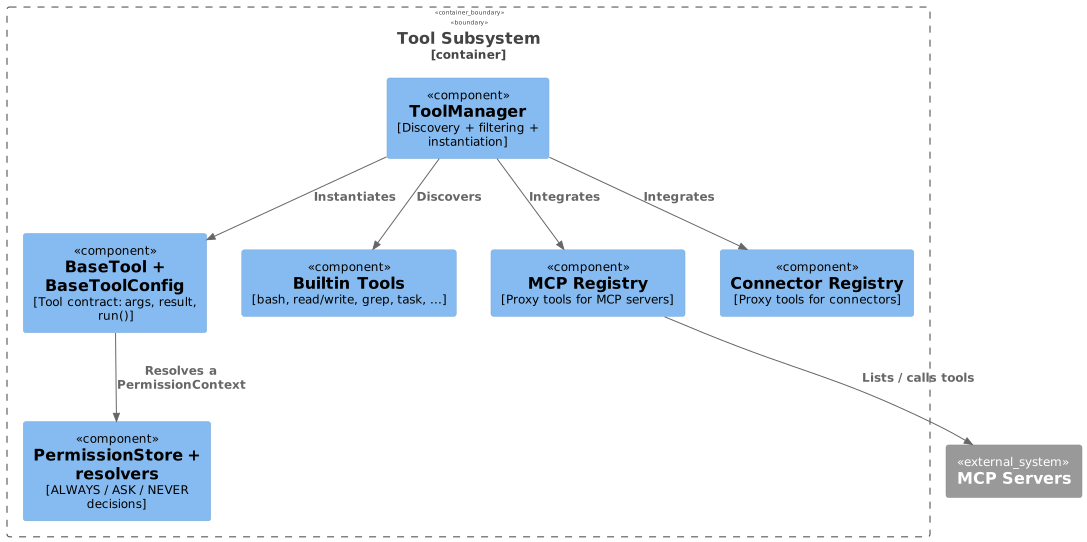
The ToolManager scans search paths for BaseTool subclasses and merges
in MCP and connector proxy tools [vibe/core/tools/manager.py:120-383].
Each tool declares a BaseToolConfig permission tier; before execution
the loop resolves a PermissionContext and consults the PermissionStore
for session-remembered approvals
[vibe/core/tools/base.py:83-113, vibe/core/tools/permissions.py:47-68].
The numeric limits each builtin tool enforces are listed as system use
cases in ../../use-cases-vibe.adoc and as quality scenarios in
Quality Requirements.
6. Runtime View
Nine scenarios cover the system at runtime. Three are error or recovery scenarios: Context Auto-Compaction, User Interruption and LLM Rate-Limit. Together the scenarios exercise every building block from Building Block View.
6.1. Startup and Session Resume
On launch the front end resolves the working directory and trust, builds configuration, then either starts fresh or restores a past session.
-
The Config Subsystem walks project
.vibe/directories (BFS, up to four levels) then the user~/.vibe/layer and merges them [vibe/core/paths/_local_config_walk.py:132-168, vibe/core/config/builder.py:24-122]. -
--continueresolves the latest session for the current TTY/working directory;--resume [ID]loads a specific session or opens a picker. Both requiresession_logging.enabled[vibe/cli/cli.py:128-190, vibe/core/session/session_loader.py:64-116]. -
Restored non-system messages are replayed into the Agent Loop and the session id / parent id are reattached [vibe/cli/cli.py:180-190].
6.2. Conversation Turn (happy path)
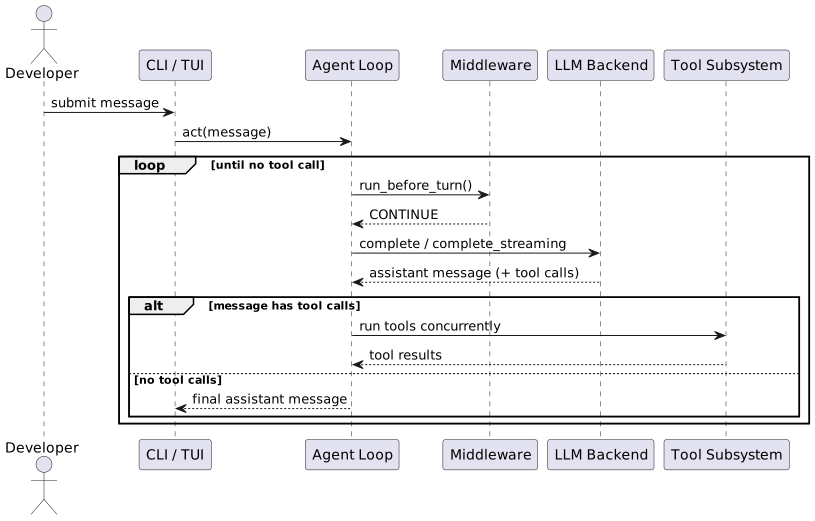
_conversation_loop appends the user message, runs the middleware
pipeline, performs the LLM turn, and executes any tool calls as
concurrent asyncio tasks before looping again
[vibe/core/agent_loop.py:855-937, vibe/core/agent_loop.py:1217-1259].
6.3. Tool Approval Interception
Before a tool runs, _execute_tool_call resolves its permission. An
ASK tier invokes the approval callback into the UI; a rejection
increments tool_calls_rejected and feeds a rejection result back to the
LLM so the conversation continues
[vibe/core/agent_loop.py:1071-1167, vibe/core/tools/permissions.py:47-68].
Approved patterns are remembered in the PermissionStore for the rest of
the session.
6.4. Context Auto-Compaction (recovery scenario)
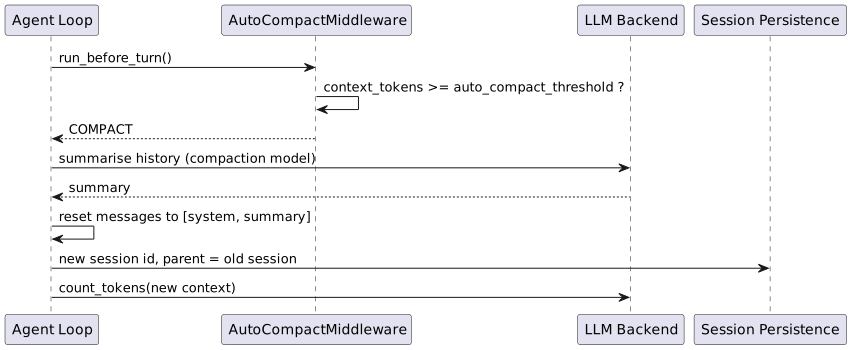
When context_tokens crosses the model’s auto_compact_threshold,
AutoCompactMiddleware returns COMPACT; the loop summarises the
history into [system, summary], forks to a new session id linked to its
parent, and recounts tokens
[vibe/core/middleware.py:81-96, vibe/core/agent_loop.py:1681-1749].
6.5. User Interruption (error / recovery scenario)
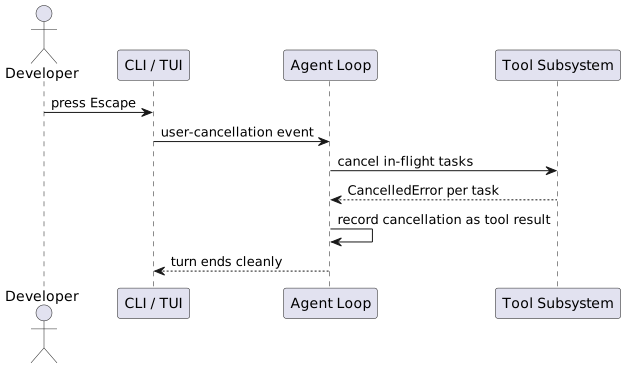
Escape raises a user-cancellation event; in-flight tool tasks receive
asyncio.CancelledError, the cancellation is recorded as a tool result,
and the loop breaks without corrupting the message history
[vibe/core/agent_loop.py:897-906, vibe/core/agent_loop.py:1170-1178, vibe/core/agent_loop.py:1244-1259].
6.6. LLM Rate-Limit / Context-Too-Long (error scenario)
_chat catches rate-limit and context-too-long errors raised by the LLM
Backend Layer and surfaces them distinctly; the Mistral backend retries
transient failures with exponential backoff before the error propagates;
the ACP Bridge maps a context-too-long failure to a JSON-RPC
ContextTooLongError
[vibe/core/agent_loop.py:1365-1374, vibe/core/llm/backend/mistral.py:212-222, vibe/acp/exceptions.py:107].
6.7. Teleport to Cloud
/teleport (gated by plan eligibility) validates the git repository,
confirms the working commit is pushed, then starts a remote Vibe Code
workflow; RemoteEventsSource attaches and streams the cloud workflow’s
events back into the UI
[vibe/core/teleport/teleport.py:46-150, vibe/core/teleport/git.py:27-100, vibe/core/nuage/remote_events_source.py:33-120].
6.8. ACP Session
vibe-acp runs VibeAcpAgentLoop, the ACP agent (see
Building Block View), as an ACP agent over stdio. The agent
holds one AcpSessionLoop per ACP session: new_session creates a fresh
AcpSessionLoop with the default agent; load_session replays a past
conversation. ACP-specific tools delegate file and terminal operations to
the connected ACP client
[vibe/acp/session.py:11, vibe/acp/acp_agent_loop.py:614-648, vibe/acp/acp_agent_loop.py:869-920, vibe/acp/tools/base.py:13-54].
6.9. First-Run Onboarding
When no API key is configured, the Setup block walks the user through
Welcome → auth-method → browser sign-in or manual API key, then persists
the key to ~/.vibe/.env (or keyring)
[vibe/setup/onboarding/screens/welcome.py:46-80, vibe/setup/auth/api_key_persistence.py:38-64].
7. Deployment View
7.1. Infrastructure Level 1
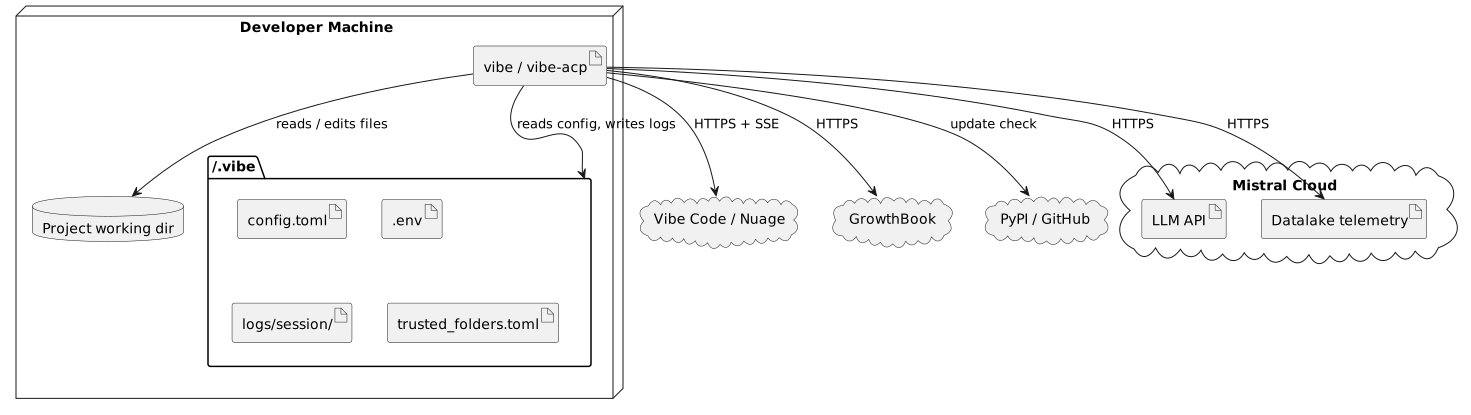
- Motivation
-
Vibe is a client-side tool. The only "deployment" is the package installed on the developer’s machine; there is no server component owned by this bounded context. All server-side systems are external (Context and Scope).
- Quality and/or Performance Features
-
The process is single-user and single-process. State lives under
~/.vibe/(overridable withVIBE_HOME):config.toml,.env, session logs, the trust list, plans and the update cache [vibe/core/paths/_vibe_home.py:19-36]. - Mapping of Building Blocks to Infrastructure
-
All nine building blocks run inside the single vibe/ (or
vibe-acp) process on the developer machine. The Remote block additionally talks to the Vibe Code / Nuage cloud.
7.2. Infrastructure Level 2 — Distribution channels
| Channel | Evidence |
|---|---|
PyPI package |
|
One-line scripts/install.sh (Linux / macOS) |
|
Standalone binary built with PyInstaller |
vibe-acp.spec, pyinstaller/runtime_hook_truststore.py, .github/workflows/build-and-upload.yml |
Packaged GitHub Action ( |
|
Zed editor extension |
Releases are cut by the .github/workflows/release.yml workflow; CI runs in .github/workflows/ci.yml [.github/workflows/].
8. Cross-cutting Concepts
8.1. Threat Model (STRIDE)
|
Warning
|
No STRIDE threat model exists in the code base. The threats below are
candidate threats, derived in Phase 2 from the code-visible risk
surfaces (see Risks and Technical Debts). The completeness of this
catalogue and the validation of each threat are deferred to the
Architect and Operations — see ADR review and |
| T-ID | STRIDE | Candidate Threat | Risk |
|---|---|---|---|
T-001 |
Tampering, Elevation |
The LLM emits a destructive shell command and |
R-001 |
T-002 |
Information Disclosure |
A file tool reads a secret file such as |
R-002 |
T-003 |
Tampering |
A file write or patch lands outside the working directory [vibe/core/tools/utils.py:64-125]. |
R-003 |
T-004 |
Information Disclosure |
|
R-002 |
T-005 |
Elevation of Privilege |
An untrusted project’s |
R-004 |
T-006 |
Spoofing, Information Disclosure |
The Mistral API key leaks from disk [vibe/setup/auth/api_key_persistence.py:14-16]. |
R-005 |
T-007 |
Tampering |
A malicious hook command runs as a shell subprocess [vibe/core/hooks/executor.py:11-55]. |
R-006 |
8.2. Security
Every mitigation references the T-IDs it closes.
| Mechanism | Description | Closes |
|---|---|---|
Tiered tool permissions |
Each tool resolves to |
T-001, T-004 |
Command allow/deny lists + arity |
|
T-001 |
Sensitive-pattern gating |
File and search tools treat |
T-002 |
Working-directory boundary |
File tools require paths inside the working directory (or an
|
T-003 |
Trust-folder gate |
A folder containing |
T-005 |
Secret storage |
API keys are stored in |
T-006 |
Read-only agent profiles |
The |
T-001, T-003 |
Experimental-hooks gate |
Hooks are disabled unless |
T-007 |
8.3. Test
The test concept is a pytest suite (pytest + pytest-asyncio
respx + pytest-textual-snapshot) with test doubles named Fake* in
tests/stubs/ [AGENTS.md:84-92]. CI runs the suite plus strict pyright
and ruff [.github/workflows/ci.yml].
|
Warning
|
Tests are not traced to use cases or business rules, and the pyramid
shape (unit / integration / end-to-end proportions) is not declared.
Establishing per-use-case traceability — each test naming the
|
8.4. Observability
-
Tracing. OpenTelemetry spans wrap the agent invocation and each tool execution, with the conversation id propagated as OTEL baggage; the OTLP exporter is enabled only when telemetry and OTEL config are present [vibe/core/tracing.py:23-137].
-
Logging. Structured stdlib logging writes to
~/.vibe/logs/vibe.log; level and rotation size are env-configurable [AGENTS.md:68-69]. -
Usage telemetry. Usage events go to the Mistral datalake, gated by
enable_telemetryand the presence of an API key [vibe/core/telemetry/send.py:58-95]. -
ACP message log. When
VIBE_ACP_LOGGING_ENABLEDis set, every ACP protocol message is recorded [vibe/acp/acp_logger.py:17-59].
8.5. Error Handling
-
Retry and backoff. The Mistral backend retries transient failures — 500 ms initial delay, 1.5x exponent, 300 s cap [vibe/core/llm/backend/mistral.py:212-222].
-
Distinct LLM failures. Rate-limit and context-too-long errors are caught and surfaced distinctly rather than as generic failures [vibe/core/agent_loop.py:1365-1374].
-
Hook retry limit. Hooks retry at most three times before being reported as failed [vibe/core/hooks/manager.py:28-53].
-
Fail-open experiments. The GrowthBook client returns defaults on any error so a flag-service outage never blocks a session [vibe/core/experiments/client.py:43-76].
-
Cancellation.
asyncio.CancelledErroris handled explicitly so user interruption ends a turn cleanly [vibe/core/agent_loop.py:1170-1178]. -
Exception discipline. Module-local exception hierarchies are chained with
raise … from e[AGENTS.md:71].
8.6. Configuration
Configuration is layered and merge-aware: project .vibe/config.toml
directories are walked breadth-first (up to four levels) and then the
user ~/.vibe/config.toml layer is applied; layers merge field-by-field
with declared strategies (replace, concat, union, shallow, conflict)
[vibe/core/config/builder.py:24-122, vibe/core/paths/_local_config_walk.py:132-168].
VIBE_HOME relocates the entire user state directory
[vibe/core/paths/_vibe_home.py:19-25]. This concept is listed because
the system genuinely has a configuration concern that crosses every
building block.
9. Architecture Decisions
The decisions below are recovered from code. The rationale — why each
was chosen over alternatives — could not be recovered, so each ADR has
status Accepted (inferred) and its Pugh Matrix marks team-judgment
cells with ?. The full ADRs are in the register at ../../adrs/.
9.1. ADR Index
| ADR | Title | Status |
|---|---|---|
Hexagonal Ports and Adapters |
Accepted (inferred) |
|
Pluggable LLM Backend Abstraction |
Accepted (inferred) |
|
Conversation Middleware Pipeline |
Accepted (inferred) |
|
File-based Session Persistence |
Accepted (inferred) |
9.2. Summary
ADR-001 — Hexagonal Ports and Adapters. The engine isolates the domain
behind *_port.py interfaces with adapters at the edges
[AGENTS.md:13-23]. Concretised in Cross-cutting Concepts (Configuration,
Observability).
ADR-002 — Pluggable LLM Backend Abstraction. BACKEND_FACTORY maps a
provider enum to a backend, and API-style adapters cover OpenAI,
Anthropic and Vertex shapes
[vibe/core/llm/backend/factory.py:7, vibe/core/llm/format.py:58-185].
Concretised by the Compatibility goal in Solution Strategy.
ADR-003 — Conversation Middleware Pipeline. A before_turn pipeline
enforces turn/price limits, auto-compaction and read-only agent modes
[vibe/core/middleware.py:218-247]. Concretised by the Security and
Reliability mechanisms in Cross-cutting Concepts.
ADR-004 — File-based Session Persistence. Sessions persist as a folder
of meta.json + messages.jsonl, with a v1→v2 migration in code
[vibe/core/session/session_logger.py:62-97, vibe/core/session/session_migration.py:16-41].
|
Note
|
The "why" behind all four decisions is deferred to the Architect
(see |
10. Quality Requirements
10.1. Quality Requirements Overview
The quality tree covers all eight ISO/IEC 25010 characteristics. Each is marked either as concretising a Chapter 1.2 top goal or as derived (a quality requirement visible in code but not among the top goals).
| Characteristic | Relation to Chapter 1.2 | Note |
|---|---|---|
Security |
Concretises Security / Safety |
Permission tiers, trust gate, secret storage. |
Usability |
Concretises Usability |
TUI, onboarding, autocompletion. |
Maintainability |
Concretises Maintainability |
Hexagonal ports, strict static analysis. |
Compatibility |
Concretises Compatibility |
Multi-provider, MCP, ACP. |
Reliability |
Concretises Reliability |
Retry, limits, recovery. |
Functional Suitability |
Derived |
Tool suite + agent loop deliver the stated function. |
Performance Efficiency |
Derived |
Concurrent tools, streaming, bounded I/O. |
Portability |
Derived |
Cross-platform; UNIX is the supported target. |
|
Warning
|
Both the selection of the Chapter 1.2 top goals — and therefore the concretises / derived split in the table above — and the priority ranking of the quality goals are deferred to the Product Owner and Architect: the code cannot rank the eight ISO/IEC 25010 characteristics (Question Tree Q4.9). The scenarios below are testable on their own, but which to favour when they conflict is an unresolved decision. |
10.2. Quality Scenarios
Each scenario is in the six-part form. Every response measure is recovered from code — a literal figure where the code defines one, otherwise the observable outcome (a clean cancellation, the model-supplied compaction threshold) — so the requirement is testable.
| Source | Stimulus | Artifact | Environment | Response | Response Measure |
|---|---|---|---|---|---|
LLM |
Emits a shell command |
|
Interactive session, |
Tool prompts for approval, then runs the command with a timeout |
Default timeout 300 s (overridable); stdout+stderr captured to a 16 000-byte cap [vibe/core/tools/builtins/bash.py:222-226] — Security. |
LLM |
Requests a code search |
|
Large repository |
Search returns within the timeout, capped |
Timeout 60 s; at most 100 matches and 64 000 output bytes [vibe/core/tools/builtins/grep.py:43-51] — Performance Efficiency. |
LLM |
Reads a large file |
|
Any session |
File content is returned truncated, with |
Read cap 64 000 bytes per call [vibe/core/tools/builtins/read_file.py:65-66] — Performance Efficiency. |
Conversation |
Context tokens approach the model limit |
Agent Loop + compaction |
Long interactive session |
History is summarised and the session forks |
Triggered at the model’s |
LLM Provider |
Returns a transient error |
Mistral backend |
Network instability |
The request is retried with exponential backoff |
500 ms initial delay, 1.5x exponent, 300 s cap [vibe/core/llm/backend/mistral.py:212-222] — Reliability. |
MCP Server |
Is slow to start or respond |
MCP registry |
External tool provider configured |
Startup and per-call are bounded by timeouts |
Startup 10 s, tool call 60 s (defaults) [vibe/core/config/_settings.py:231-237] — Compatibility. |
Developer |
Presses Escape mid-turn |
Agent Loop |
Tool tasks running |
In-flight tool tasks are cancelled and the turn ends cleanly |
All running tasks receive |
Hook author |
Configures a slow hook |
Hooks manager |
|
The hook is killed on timeout and retried a bounded number of times |
Default timeout 30 s; at most 3 retries [vibe/core/hooks/models.py:30, vibe/core/hooks/manager.py:28] — Reliability. |
Maintainer |
Submits a code change |
CI pipeline |
Pull request |
Pyright (strict) and ruff must pass before merge |
Zero type errors, zero lint errors [AGENTS.md:24-46] — Maintainability. |
11. Risks and Technical Debts
11.1. Risks
Risks are ordered by priority (highest first). Priority is derived from
probability × impact. The probability and impact values are inferred
in Phase 2 and must be confirmed by a security review — see ADR review
and OPEN_QUESTIONS.adoc (Q3.8.1).
| ID | Risk | Prob. | Impact | Priority | Mitigation |
|---|---|---|---|---|---|
R-007 |
No STRIDE threat model backs the security mechanisms, so threat completeness is unverified (no code evidence — deferred). |
High |
Medium |
High |
Author a STRIDE threat model (deferred — Architect, Operations). The candidate threats T-001..T-007 in Cross-cutting Concepts are the starting point. |
R-001 |
The LLM emits a destructive shell command and |
Medium |
High |
High |
Tiered tool permissions + command allow/deny lists
(Cross-cutting Concepts Security); |
R-004 |
An untrusted project’s |
Medium |
High |
High |
Trust-folder gate (Cross-cutting Concepts Security). |
R-002 |
A secret file is read, or |
Medium |
Medium |
Medium |
Sensitive-pattern gating and |
R-003 |
A file write or patch lands outside the working directory (threat T-003). |
Low |
High |
Medium |
Working-directory boundary (Cross-cutting Concepts Security). |
R-005 |
The Mistral API key leaks from disk (threat T-006). |
Low |
High |
Medium |
Keyring storage and RSA+AES payload encryption (Cross-cutting Concepts Security). |
R-006 |
A malicious hook command runs as a shell subprocess (threat T-007). |
Low |
High |
Medium |
Experimental-hooks gate (Cross-cutting Concepts Security) — hooks run
only when |
R-008 |
A large pinned dependency surface (~80 direct dependencies) carries supply-chain exposure; no SBOM or scanning config is in the bounded context [pyproject.toml:30-141]. |
Medium |
Medium |
Medium |
uv.lock pins every transitive dependency; |
R-009 |
Behaviour on a sustained LLM-provider outage (beyond retry exhaustion) is not specified in code (deferred). |
Medium |
Low |
Low |
Retry/backoff scenario in Quality Requirements; the intended end-state is deferred to Operations. |
R-010 |
No performance budget exists in code for very large repositories (deferred). |
Low |
Low |
Low |
Byte-capped file reads and auto-compaction bound growth; an explicit budget is deferred. |
11.2. Technical Debt
Each item names the Chapter 5 building block it burdens.
| ID | Burdened Building Block | Debt | Evidence |
|---|---|---|---|
TD-001 |
Agent Loop |
|
|
TD-002 |
ACP Bridge |
|
|
TD-003 |
Session Persistence |
A v1→v2 session-format migration is carried in code; it can be removed once all users have migrated. |
|
TD-004 |
CLI / Textual UI |
The TUI widget layer is large (~70 widget modules) and untiered, which makes the front end the least diffable part of a recovery run. |
|
TD-005 |
CLI / Textual UI |
Voice mode is shipped but marked experimental and "may change". |
12. Glossary
| Term | Definition |
|---|---|
Agent |
A configured run profile of the engine; built-in profiles are
|
Subagent |
An agent of type |
Agent Profile |
The data record for an agent: name, safety tier, agent type and config overrides [vibe/core/agents/models.py:48-94]. |
Agent Loop |
The orchestrator that runs a conversation turn — LLM call plus tool execution — until no tool call remains [vibe/core/agent_loop.py:855-937]. |
Tool |
A |
Tool Permission |
The tier — |
Skill |
A reusable component declared by a |
MCP Server |
An external tool provider reached over the Model Context Protocol
( |
Connector |
A remote tool source registered through the connector registry [vibe/core/tools/connectors/connector_registry.py]. |
Hook |
A TOML-declared shell command run on a lifecycle event such as
|
Session |
A persisted conversation: a folder of |
Compaction |
Summarising the conversation history when the context nears the model’s token threshold [vibe/core/agent_loop.py:1681-1749]. |
Plan Mode |
The read-only |
Teleport |
Handing a local session to a remote Vibe Code workflow [vibe/core/teleport/teleport.py:46-150]. |
Nuage |
The remote cloud workflow backend (French for "cloud") [vibe/core/nuage/client.py:22-100]. |
Trust Folder |
A directory the user has explicitly trusted; only trusted folders load
project |
ACP |
Agent Client Protocol — the JSON-RPC-style protocol the |
VIBE_HOME |
The user-state directory, |
Feedback
Was this page helpful?
Glad to hear it! Please tell us how we can improve.
Sorry to hear that. Please tell us how we can improve.