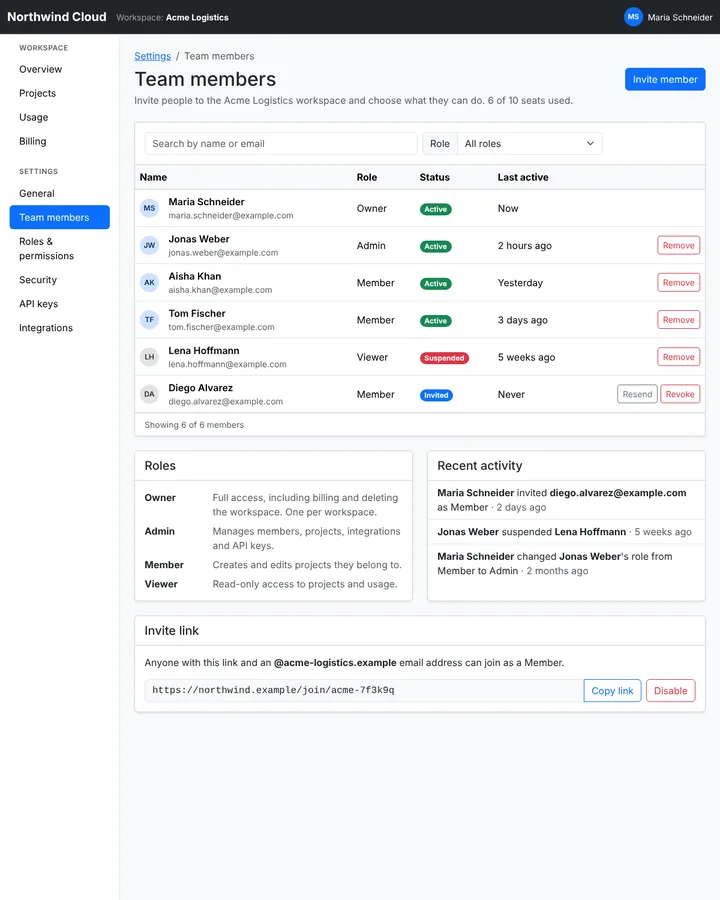
Bootstrap 5 is the fifth major version of the front-end toolkit that Mark Otto and Jacob Thornton released at Twitter in 2011. It provides a 12-column flexbox grid with six breakpoints, a utility API, Sass and CSS custom properties, colour modes since 5.3 and ready-made components with class names such as form-control and btn-primary, and it no longer depends on jQuery.
Bootstrap 5
Details
- Full Name
-
Bootstrap 5 — the fifth major version of Bootstrap, released on 5 May 2021
- Also known as
-
Bootstrap, Twitter Bootstrap (originally "Twitter Blueprint"), BS5
Core Concepts:
-
A 12-column grid on flexbox. Containers, rows and columns with six breakpoints: xs below 576 px, then sm, md, lg, xl and xxl from 576, 768, 992, 1200 and 1400 px (Grid).
-
Components by class name.
btn btn-primary,card,navbar,modal; forms useform-label,form-control,form-checkand the validation statesis-invalidwithinvalid-feedback. -
Utilities from a utility API. Spacing, display and flex classes such as
mb-3,d-flexandgap-2, generated from a Sass map that projects can extend. -
No jQuery. Version 5 dropped jQuery and Internet Explorer; JavaScript plugins are configured through
data-bs-attributes (v5 alpha announcement). -
Colour modes. Since 5.3 the core supports dark mode and further colour modes through CSS custom properties (v5.3.0).
- Key Proponents
-
Mark Otto and Jacob Thornton, who built it at Twitter and open-sourced it on 19 August 2011 (Wikipedia). Mark Otto still leads the project and writes its release posts
When to Use:
-
Building a conventional, responsive interface quickly with familiar components, such as an internal tool, a prototype or a server-rendered app. In our prior test, every anchor run of a sign-up form used
form-control,form-label,form-check,is-invalidwithinvalid-feedbackandbtn btn-primary; no baseline used a Bootstrap class. -
Generating plain HTML and CSS that other developers recognise at a glance
-
Theming through Sass variables or CSS custom properties instead of writing a design system from scratch
Common Misunderstandings:
-
Saying "Bootstrap" without a version. Versions 3, 4 and 5 differ in grid, class names and JavaScript; Bootstrap 4 still needs jQuery. The number pins the API.
-
Confusing it with bootstrapping. In statistics the bootstrap is Efron’s resampling method (The Annals of Statistics, 1979); in other contexts it means starting a system or a company. "Bootstrap 5" names the CSS toolkit.
-
Equating Bootstrap with its default look. The defaults are a starting theme. Sass variables and, since 5.3, CSS custom properties change colours, radii and spacing.
Criticism:
-
Sites that look alike. Owen Williams, "Web design is now completely boring" (The Next Web, 2015), blamed frameworks for uniform web design: "Everything quickly starts looking the same because nobody can be bothered customizing Bootstrap enough to make it look unique".
Current Status:
-
Bootstrap 6 is in alpha. The latest stable release is 5.3.8 (August 2025); its post announced 5.4.0 as next. Bootstrap 6 Alpha followed on 8 October 2026 with Sass modules, CSS layers, responsive class names such as
md:d-noneinstead ofd-md-none, and ESM-only JavaScript without awindow.bootstrapglobal; 5.4.0 is to ship before version 5 gets an end-of-life date (Bootstrap 6 Alpha). "Bootstrap 5" pins the stable API; ask for version 6 explicitly and give the link, since the prior predates it.