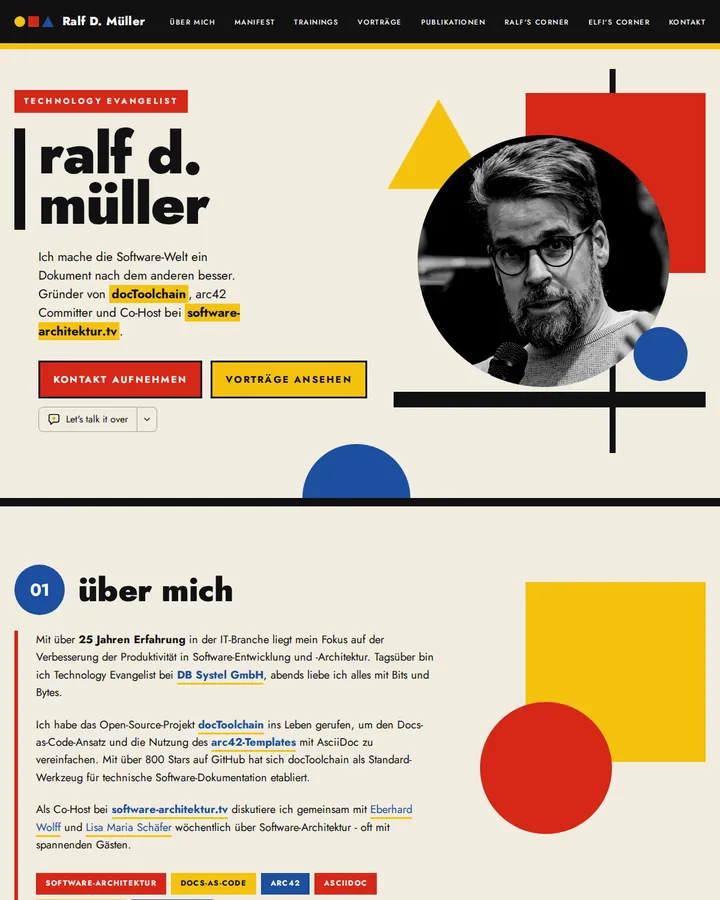
Bauhaus was the German school of design founded by Walter Gropius in Weimar in 1919 and closed in Berlin in 1933. As a design instruction, the name evokes the style later drawn from it: form follows function, basic geometric shapes such as circle, square and triangle, primary colours, geometric sans-serif type and the unity of art, craft and industry.
Bauhaus
Details
- Full Name
-
Staatliches Bauhaus — the German school of art, craft and design that ran from 1919 to 1933 in Weimar, Dessau and Berlin
- Also known as
-
Staatliches Bauhaus in Weimar, Bauhaus Dessau, Bauhaus design
Core Concepts:
-
A school, not a style. Walter Gropius became director of the "Staatliches Bauhaus in Weimar" in March 1919 and published the Bauhaus Manifesto in April. The name stands for an institution with a teaching programme, not for one look.
-
Three directors, three programmes. Gropius led the school until he resigned in 1928. Hannes Meyer followed in April 1928, Ludwig Mies van der Rohe in 1930. Each changed what the school taught.
-
Three cities. Dessau took the school over in 1925 and approved a new building in June that year. In 1932 the Dessau council dissolved it, and Mies reopened it privately in Berlin-Steglitz in October.
-
Craft before industry. The early Weimar years were craft-based and expressionist. The functional, industrial image came later and covers only part of the school’s history.
-
Teaching through workshops. Students worked in workshops such as the weaving workshop. Which workshop a student entered shaped what they made — and, as critics note, who was allowed where.
-
A forced end. Police searched the Berlin school in April 1933. In July 1933 Mies dissolved it with the faculty’s consent.
- Key Proponents
-
Walter Gropius (founder and director 1919–1928, author of the Bauhaus Manifesto); Hannes Meyer (director 1928–1930); Ludwig Mies van der Rohe (director 1930–1933, reopened the school in Berlin and dissolved it in 1933). Chronology after the catalogue 50 Jahre Bauhaus (Stuttgart 1968), as given by bauhaus-bookshelf.org
When to Use:
-
Landing pages, posters and brand work that should be built from geometric forms, primary colours and a geometric sans instead of photography and hand-drawn elements
-
As a counter-instruction when generated designs drift towards stock photos and script fonts
-
Design history and teaching, when the topic is the school itself: its directors, its workshops, its moves from Weimar to Dessau to Berlin
Common Misunderstandings:
-
Treating it as one visual style. The Bauhaus was a school with three directors and changing programmes. "Bauhaus style" names a later reading of part of its work.
-
Assuming it was purely functionalist and industrial. The early Weimar years were craft-based and expressionist.
-
Equating it with the International Style. The International Style is a later movement; the Bauhaus was one school with its own history.
-
Using the bare name. In our prior test on 2026-10-28, the bare "Bauhaus" resolved to art and design history on every tier; Opus also mentioned the band and the DIY chain. "Bauhaus design" changed the output: all six baselines built a bakery page around photography with hand-drawn or script elements, while all six anchor runs used geometric forms, a geometric sans and the primary colours.
Criticism:
-
Progressive image, segregated practice. Theresia Enzensberger writes in "The 'Bauhaus women'" (Goethe-Institut, October 2018, translated by Jo Beckett) that the school steered women into the weaving workshop and their numbers fell: "Gropius' segregation was showing its effects".
-
An aesthetic imposed on the people it claimed to serve. Scott Alexander, in "Book Review: From Bauhaus to Our House" (Astral Codex Ten, 4 December 2024), follows Tom Wolfe’s polemic: modernism forced its taste on workers who did not share it. "Ironically, real workers hated the modernist styles."